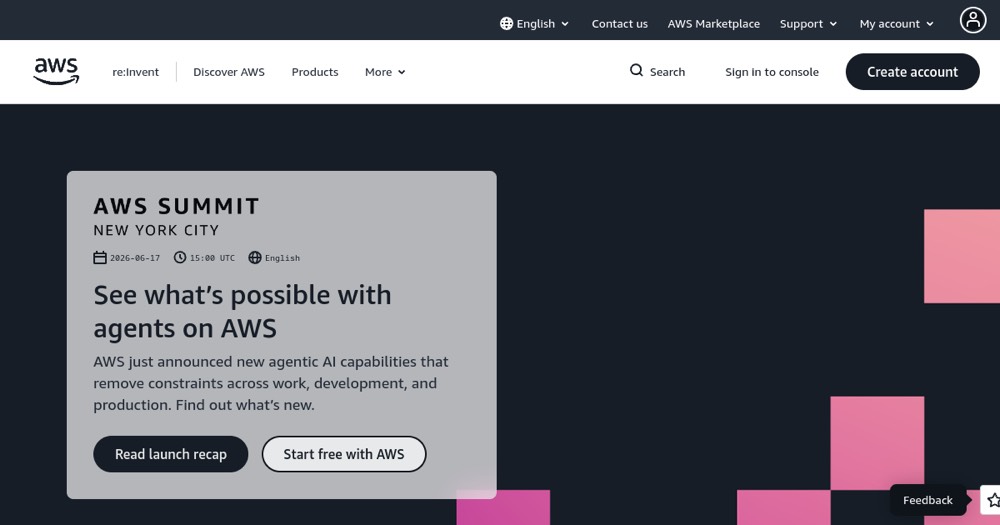
There is no fixed comparison price: budget per service and consumption, and track the 12-month Free Tier limits before they expire.
About
In practice. What you can do with AWS.
AWS covers compute (EC2, Lambda), storage (S3), databases, networking and AI/ML through hundreds of independently priced, managed services rather than one bundled product. There is no flat plan: every service bills by actual consumption, which gives flexibility but makes budgeting harder without dedicated cost tooling.
A Free Tier combines always-free limits, 12 months of free resources for new accounts, and time-limited trials on specific services; beyond that, cost is entirely usage-based, with Reserved Instances, Savings Plans or Spot Instances cutting the on-demand rate for stable or interruptible workloads. It fits a developer or technical team running infrastructure directly, more than someone who wants one predictable monthly price.
Practical uses
DeployRun a web app's compute, storage and database on pay-as-you-go pricing without committing to a fixed plan.
SaveCommit to a 1 to 3-year Reserved Instance or Savings Plan on stable workloads to cut the on-demand rate.
Features & use cases
Devops
Pros and cons. What AWS does well, and what to expect.
Pros
Breadth of managed services covers compute, storage, database, networking and AI/ML in one account.
Free Tier gives 12 months of free resources plus always-free limits for new accounts.
Cons
No flat, predictable price: cost varies continuously with usage across many billable dimensions.
Breadth of services creates a steep learning curve compared to single-purpose hosting platforms.
When it makes sense. Keep AWS, or challenge it?
Keep if
You or your team deploy and run infrastructure directly and need the breadth of services AWS covers.
Challenge if
You want one flat monthly price or don't have the time to manage usage-based billing across services.
Pricing. What does AWS cost ?
Pay-as-you-go (on-demand)
Custom quote.
No fixed price: billed per-service, per-unit of consumption (compute hours, storage GB, requests, etc.) across hundreds of independently priced services.
Commitment discounts (Savings Plans, Reserved Instances) can cut costs up to 72-75% and Spot Instances up to 90%, but the on-demand entry rate is hard to justify without cost-management discipline.
Simplicity
The breadth of services and configuration options creates a steep learning curve compared to single-purpose hosting platforms.
Fit for purpose
Covers compute, storage, database, networking and AI/ML as promised, across hundreds of independently working managed services.
Performance
Breadth across hundreds of managed services (compute, storage, database, networking, AI/ML) makes it a category reference for scale.
Reversibility
Neutral score: data export and migration-out procedures per service are not covered by the collected sources.
The AI angle
AWS vs AI
AI augments this tool
Go further with AI
AWS has its own AI assistant (Amazon Q) to generate infrastructure code and diagnose issues, and also hosts other companies' AI models (Bedrock) — AI sits as a layer on top of cloud infrastructure that remains the real product.
Can AI replace it?
Replace AWS with an AI? No: hosting, storage, databases, and networking for an application are infrastructure problems, not content-generation ones. AI helps write infrastructure code faster (Amazon Q), it doesn't replace the need for servers and storage. Verdict: AI augments development speed on AWS, the infrastructure remains the product.
AWS Summary
Category
productivity tool.
Price from
Price not public.
Best for
A developer or technical solo operator who deploys and runs infrastructure directly, rather than a non-technical operator who needs a flat, predictable price.
Avoid if
You want one flat monthly price or don't have the time to manage usage-based billing across services.
There is no fixed comparison price: budget per service and consumption, and track the 12-month Free Tier limits before they expire.
Frequently asked questions.
What to know before choosing AWS.
What is AWS used for?
AWS is a pay-as-you-go cloud platform for compute, storage, databases, networking and AI across hundreds of services.
How much does AWS cost?
AWS doesn't publish a price list; check the official page for current pricing. Price verified on 2026-09-25.
Is AWS suitable for beginners?
A developer or technical solo operator who deploys and runs infrastructure directly, rather than a non-technical operator who needs a flat, predictable price.
Is AWS worth the price?
There is no fixed comparison price: budget per service and consumption, and track the 12-month Free Tier limits before they expire.
What are the best alternatives to AWS?
The main alternatives to AWS are: Google Cloud, DigitalOcean, Heroku, Vercel. Free alternatives: Google Cloud.