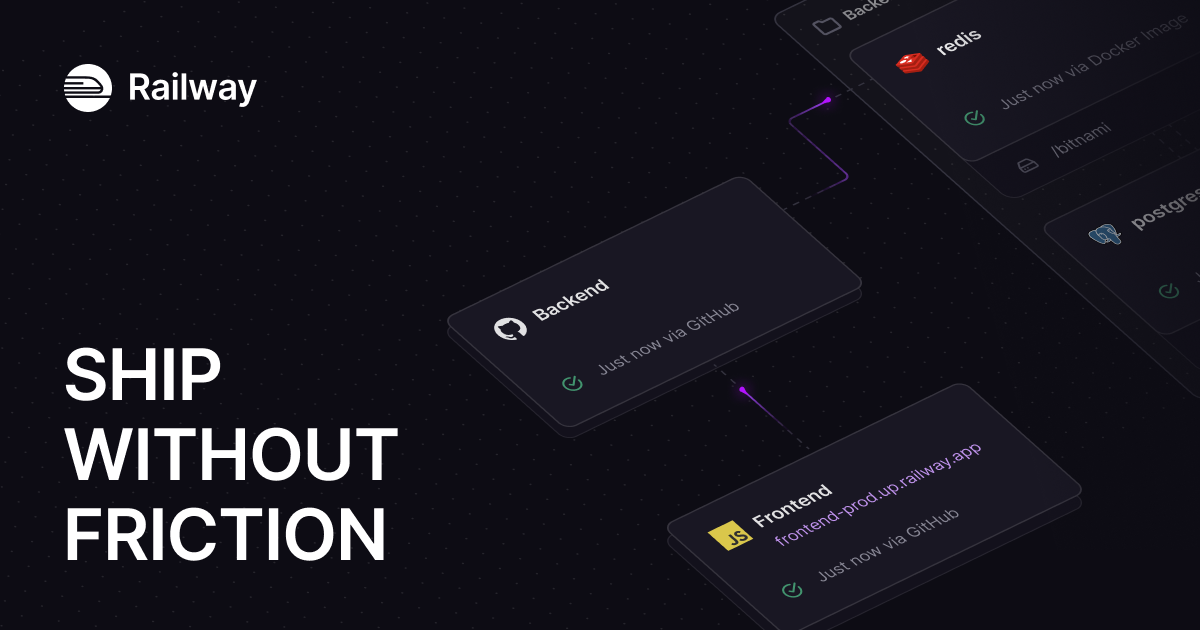
Railway makes sense for modern devs wanting to deploy quickly without complex infrastructure; for static or very simple hosting, a lighter alternative fits better.
About
In practice. What you can do with Railway.
Railway is a next-generation deployment platform that simplifies hosting apps and databases: connect your GitHub repo, and Railway automatically detects and deploys your project, with more transparent usage-based pricing than Heroku.
For an independent developer or small startup, it's often the preferred modern alternative to Heroku: clearer interface, faster deployment, and a generous free tier to test a project.
Practical uses
Deploy a REST API or web server.
Host a PostgreSQL database.
Quickly prototype without infrastructure setup.
Features & use cases
Deployment
Devops
Nocode web
Pros and cons. What Railway does well, and what to expect.
Pros
Intuitive interface and simple CLI.
Granular billing (no idle costs).
Automated git-based deployments.
Integrated databases out of the box.
Cons
Unpredictable costs if resources are poorly sized.
Fewer services than AWS/GCP.
Limited free plan.
When it makes sense. Keep Railway, or challenge it?
Keep if
You're deploying modern applications or APIs.
You prefer fine-grained billing (pay-for-use).
Railway becomes worthwhile when
+You use it at least once a week
+The monthly cost ($5) is small next to the time it saves you
Challenge if
You rarely or never deploy.
You need fully free production hosting.
Railway becomes too expensive when
−You use it less than once a month
−A simple free version or a tool already in your stack would do
Our verdict. What to know about Railway.
Why this verdict
Average
Railway is fairly easy to replace with an alternative, no free tier to test before paying, clearly documented use cases.