Mailgun is ideal for developers; for non-technical marketing teams, Brevo or Moosend offer a more user-friendly interface.
About
In practice. What you can do with Mailgun.
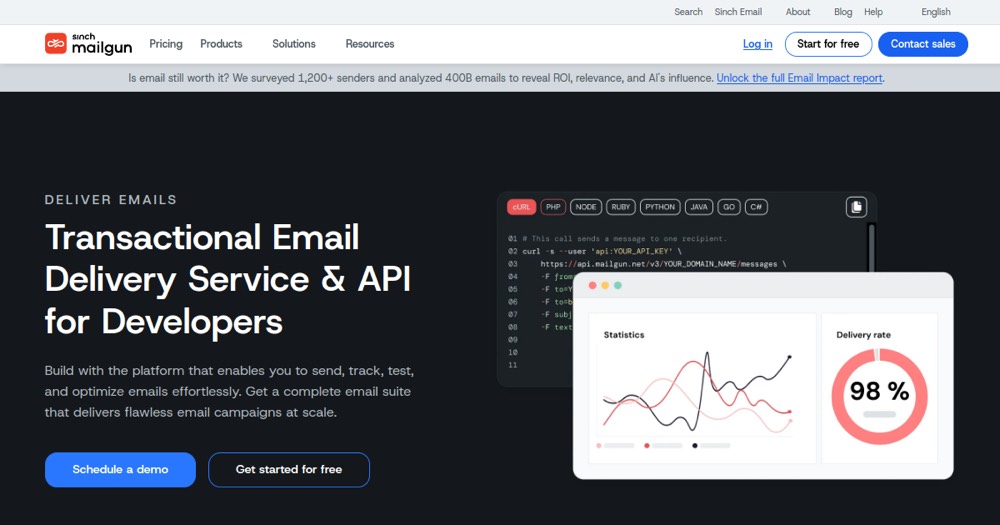
Mailgun is an email-sending API built for developers: transactional emails (confirmations, password resets), address validation, real-time tracking, and built-in SPF/DKIM/DMARC management.
Since the Sinch acquisition, several users report 20-40% price increases and a measured drop in deliverability (from 53.8% to 26.05% between Q1 2024 and Q1 2025 per GlockApps) — a point worth watching before committing. Mailgun offers no email templates or automated follow-ups: for marketing campaigns, SendGrid, Mailchimp, or Brevo are better suited.
Practical uses
Send transactional emails from SaaS apps.
Build triggered email workflows via API.
Handle bounce and complaint management at scale.
Features & use cases
Email delivery
Pros and cons. What Mailgun does well, and what to expect.
Pros
Powerful, well-documented REST API.
Strong deliverability and reputation management.
Excellent value at scale.
Flexible webhooks and logging.
Cons
Requires development work to integrate.
Limited marketing features compared to all-in-one platforms.
Shared IP on base plans.
When it makes sense. Keep Mailgun, or challenge it?
Keep if
You're a developer building an email feature into an app.
You need reliable transactional email delivery at scale.
Mailgun becomes worthwhile when
+You use it at least once a week
+The monthly cost ($10) is small next to the time it saves you
Challenge if
You need a visual campaign builder.
Your use case is very low volume (under 1,000 emails/month).
Mailgun becomes too expensive when
−You use it less than once a month
−A simple free version or a tool already in your stack would do
Our verdict. What to know about Mailgun.
Why this verdict
Average
Mailgun is fairly easy to replace with an alternative, no free tier to test before paying, clearly documented use cases.