Being free, there's no cost threshold; the real question is whether its narrower scope (66kb, no large modern ecosystem) still covers what the project needs.
About
In practice. What you can do with Knockout.
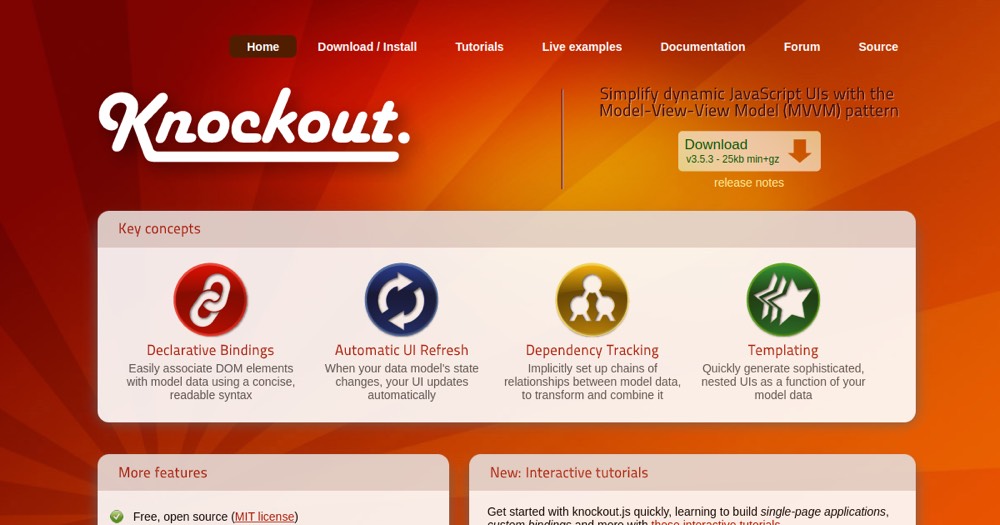
Knockout.js is a small JavaScript library that binds DOM elements declaratively to a view model: change a property in the model and the UI updates automatically, no manual DOM manipulation needed. It also tracks dependencies between properties and offers templating for dynamic UI generation.
It's free and MIT-licensed, with no pricing tiers to weigh. It suits a developer maintaining an existing Knockout codebase or wanting a lightweight, dependency-free binding library for a small project, less someone starting a new large application, where development has slowed and most tooling has moved to React or Vue.
Practical uses
Use caseBind a form's inputs to a JavaScript view model so the UI updates automatically as values change, without manual DOM manipulation.
Use caseMaintain and extend an existing legacy Knockout.js application without rewriting it in a newer framework.
Features & use cases
Legacy web
Pros and cons. What Knockout does well, and what to expect.
Pros
Completely free and open source, with no pricing decision to make.
Very small footprint (66kb minified), easy to drop into an existing page.
Cons
Development has slowed considerably, with the latest stable release stuck at 3.5.3.
Narrower scope than full modern frameworks like React or Vue.
When it makes sense. Keep Knockout, or challenge it?
Keep if
You maintain an existing Knockout.js codebase or need a minimal, dependency-free data-binding library.
Challenge if
You're starting a new large application, since development has slowed and most ecosystems have moved to React or Vue.
Our verdict. What to know about Knockout.
Why this verdict
Average
Added value
Fully free MIT-licensed library with no cost at all, so any UI it helps ship is a pure gain for the budget.
Simplicity
Declarative data-bindings are easy to read, but a developer still needs JavaScript and view-model knowledge to get a first useful result, unlike a no-code tool.
Fit for purpose
It does what it promises, binding DOM elements to a view model with automatic refresh, without needing a workaround or third-party library for that core behavior.
Performance
Deliberately small (66kb) and narrower in scope than full frameworks like React or Vue, and development has slowed considerably since its peak, which caps how far it can grow with a project.
Reversibility
As a plain open source MIT library with no vendor platform or hosted data, there is nothing to export or migrate away from beyond swapping the code for another library.