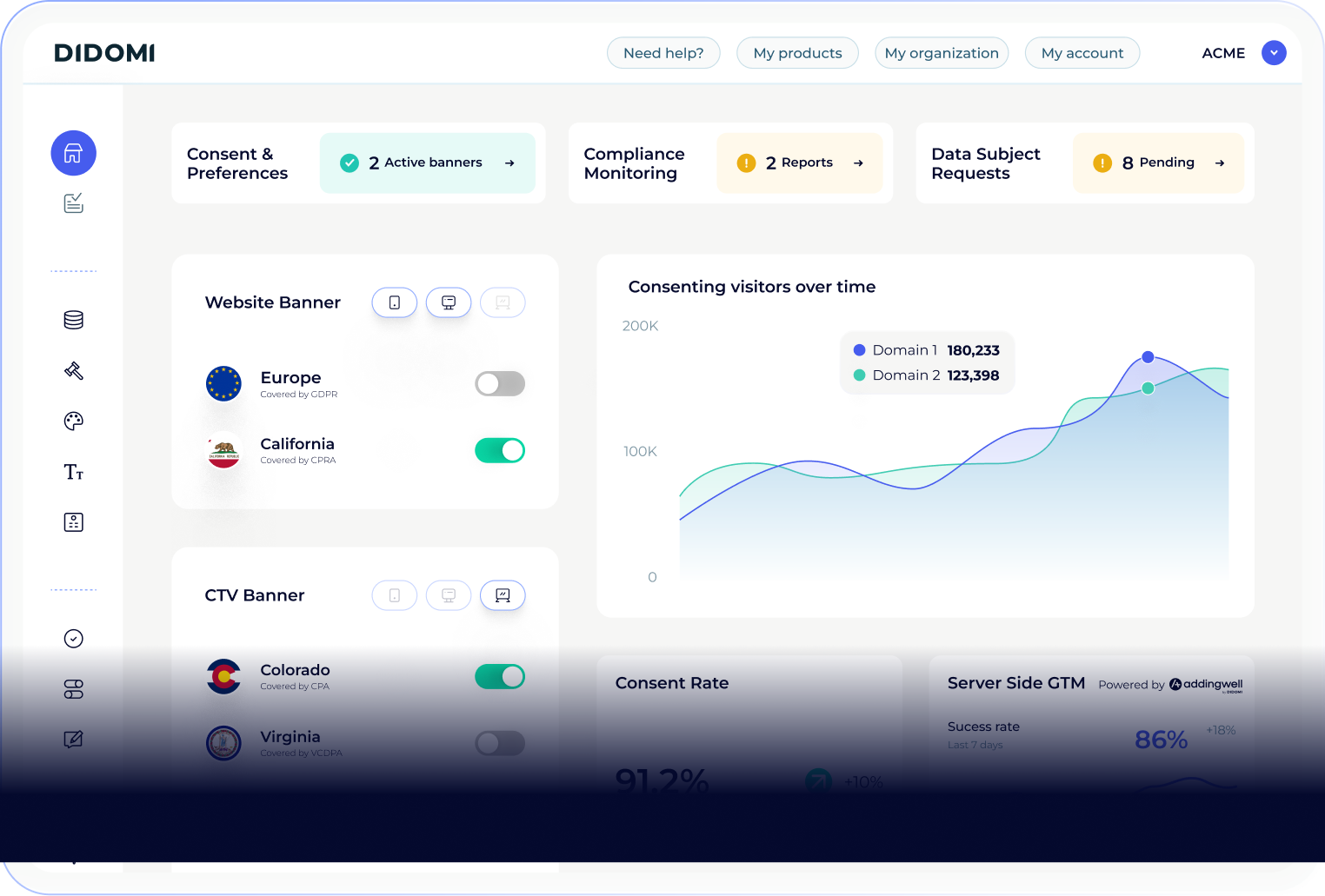
Didomi manages consent and preferences, not SOC 2 audit preparation. Its role is coordinating collection and consent propagation across properties.
CMP tiers Essential, Advanced and Premium are quote-based. CTV, preference and server-side products have separate scope and must not be used as the CMP's starting price. Monthly unique visitor volume matters.
Batch exports are documented for users with an organization user ID by default; anonymous visitors are not automatically included. Tracker integration and consent policy still require configuration.
Practical uses
Coordinate notices across websites.
Propagate preferences to marketing systems.
Monitor consent configuration.
Features & use cases
Consulting workflow
The case for and against. What Didomi does well, and when it costs too much.
For. What works in its favour.
Coordinated consent and preferences across properties.
Customizable collection experiences.
Documented batch exports.
Against. What to plan for.
CMP pricing requires a quote.
Channels and modules need scoping.
Default exports are limited to identified users.
Our verdict. What to know about Didomi.
How the score breaks down
Verdict sourceshttps://www.didomi.io/https://www.didomi.io/offershttps://developers.didomi.io/integrations/generic-integrations/batch-export/exported-dataVerified on
Added value
4/5
Centralizing preferences and propagation supports multiple properties, without invented financial gains.
Simplicity
4/5
Customizable notices and integrations support deployment; trackers still require configuration.
Fit for purpose
4/5
Collection, synchronization and monitoring are documented consent capabilities, not a claimed hands-on test.
Performance
4/5
CMP, preferences and additional channels address broad consent needs, not all GRC functions.
Reversibility
4/5
Documented batch exports require an organization user ID by default and exclude anonymous visitors automatically.