ChartMogul is essential for SaaS companies that need reliable subscription metrics; for a single product with simple billing, Stripe Reporting may suffice.
About
In practice. What you can do with Chartmogul.
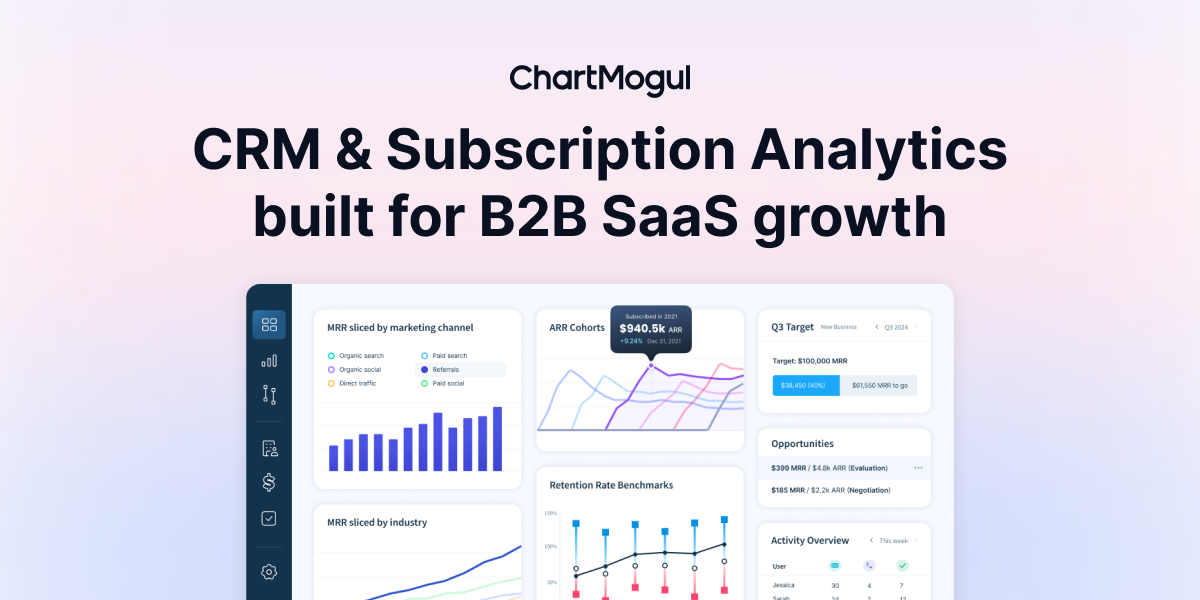
ChartMogul tracks recurring revenue metrics (MRR, churn, LTV, cohorts) in more depth than free tools such as ProfitWell, and adds a light built-in CRM for tracking sales opportunities.
A free plan covers businesses under $10K MRR, or less than $120K ARR, which is most solopreneurs during launch. Above that, the Scale plan starts at $100 a month for $10K MRR, with progressive additional cost per extra MRR band.
A startup programme takes $50 a month off for 12 months for young businesses, which softens the entry into the paid range.
Practical uses
Monitor and optimize MRR, ARR, and churn.
Consolidate billing data across multiple sources.
Forecast revenue and analyze subscription health.
Features & use cases
Consulting workflow
Pros and cons. What Chartmogul does well, and what to expect.
Pros
Specialized in SaaS metrics (MRR, ARR, churn).
Consolidates multiple billing sources.
Reliable forecasting and industry benchmarks.
Strong CRM integrations (Salesforce, HubSpot).
AI analytics to flag anomalies.
Cons
Progressive pricing can get steep for high ARR.
Learning curve for new users.
No detailed behavioral analysis (mainly financial).
When it makes sense. Keep Chartmogul, or challenge it?
Keep if
You run a SaaS or subscription business.
You need a consolidated view of MRR and churn.
Chartmogul becomes worthwhile when
+You use it at least once a week
+The monthly cost ($88) is small next to the time it saves you
Challenge if
You have a simple revenue model.
Your billing platform has solid built-in reporting.
Chartmogul becomes too expensive when
−You use it less than once a month
−A simple free version or a tool already in your stack would do
Our verdict. What to know about Chartmogul.
Why this verdict
Great
Chartmogul is fairly easy to replace with an alternative, a free tier to test before paying, clearly documented use cases.