

On this page7 sections
Being mentioned by ChatGPT, Perplexity or Google AI Search has become a marketing goal. But one test does not prove that a brand is consistently visible. To measure AI search visibility, track questions that matter to potential customers, separate Google impressions from answers on other assistants, then check whether exposure leads to visits or enquiries. This practical method avoids treating a GEO score as a guaranteed ranking.
In short: define customer questions, repeat them under comparable conditions, log the brands and sources cited, then compare those observations with Search Console and Analytics. An AI answer is a variable sample, not a universal ranking.
What does AI search visibility mean?
AI search visibility is the presence of a business, its pages or its information in generative assistant responses. A brand may be named, recommended, described without a link or shown as a clickable source. These signals are not interchangeable: a mention is not a visit, and a citation does not prove a model has a stable preference.
GEO, or Generative Engine Optimization, describes practices intended to improve that presence. Measurement methods remain uneven, so repeatable observations are more useful than comparing scores built from different prompt sets.
What changed in 2026: Google’s new reporting
Google announced new Search Console reporting for performance in its generative search experiences, including impressions, pages surfaced and country data. After initial testing in the UK, Google said the rollout was global as of August 31, 2026. Look for the AI Search views available in your Search Console property; the interface may continue to evolve. Google’s announcement.
These data help assess visibility in Google experiences. They do not measure every ChatGPT, Claude or Perplexity answer. Repeated prompts, observed citations and referral visits are complementary signals for those services, each with limitations.
A five-step method to measure AI visibility
1. Choose 10 to 20 questions close to a buying decision
Avoid vague prompts such as “tell me about my company.” Write questions a prospect might ask before choosing:
- Need: “Which invoicing tool suits an independent consultant in France?”
- Comparison: “X or Y for a three-person team that wants to automate follow-ups?”
- Constraint: “Which solution works without an annual commitment?”
- Industry or location: “Which [service] specialists support retailers in [city]?”
Mix discovery, comparison and decision questions. Record the country, language, customer type and intent for each prompt. Do not test only your brand name: that mostly measures existing awareness.
2. Keep the test protocol consistent
Choose the assistants and search modes, then save each exact prompt, country, date and visible links. Do not compare an answer with web search enabled against one without it. Model, location and conversation context can all change the result. Repeat the same prompt set at regular intervals. A single test never represents every conversation on an assistant.
3. Separate the signals you observe
- Brand mention: the name appears, but this does not prove it was recommended.
- Accurate description: the offer seems understood, but not that every answer is correct.
- Citation: a page is shown as a source, but this does not prove anyone will click it.
- Competitor mention: another option appears, but this is not market share.
- Visit or enquiry: an action is recorded, but AI was not necessarily its only cause.
You can calculate an observation rate: answers mentioning your brand divided by answers tested. Always state the number of tests and the prompt set. Do not call it “market share of voice”: it only describes your questions, countries, dates and assistants.
4. Connect visibility to real behaviour
In Search Console, track Web Search clicks and impressions, plus AI Search views if they are available in your account. In Analytics, inspect sessions from assistant domains when a referrer is passed through. Some visits may lose their source, so do not label all direct traffic as AI traffic.
Choose a conversion that matters to your business: a form, booking, signup or qualified enquiry. More mentions without visits or leads may call for a better landing page, not automatically a new GEO subscription.
5. Improve one useful page, then observe
If an assistant misunderstands your offer, correct the source you control: a clear description, target audience, current pricing, limitations, examples and coherent internal links. Google says SEO fundamentals remain useful; it does not require a special “AI file” or special Schema markup for a page to appear in its generative features. Official documentation.
Change one important element at a time and record the date. If you change pages, prompts and tools together, you will not know what helped. No vendor can guarantee that an edit will make an AI cite your page.
Should you pay for a GEO tool?
A tool becomes useful when you have a stable prompt set, multiple markets or competitors, and manual checks no longer scale. Before paying, check which models, countries and questions are covered, whether raw answers and sources are visible, how prompts are sampled and whether history can be exported.
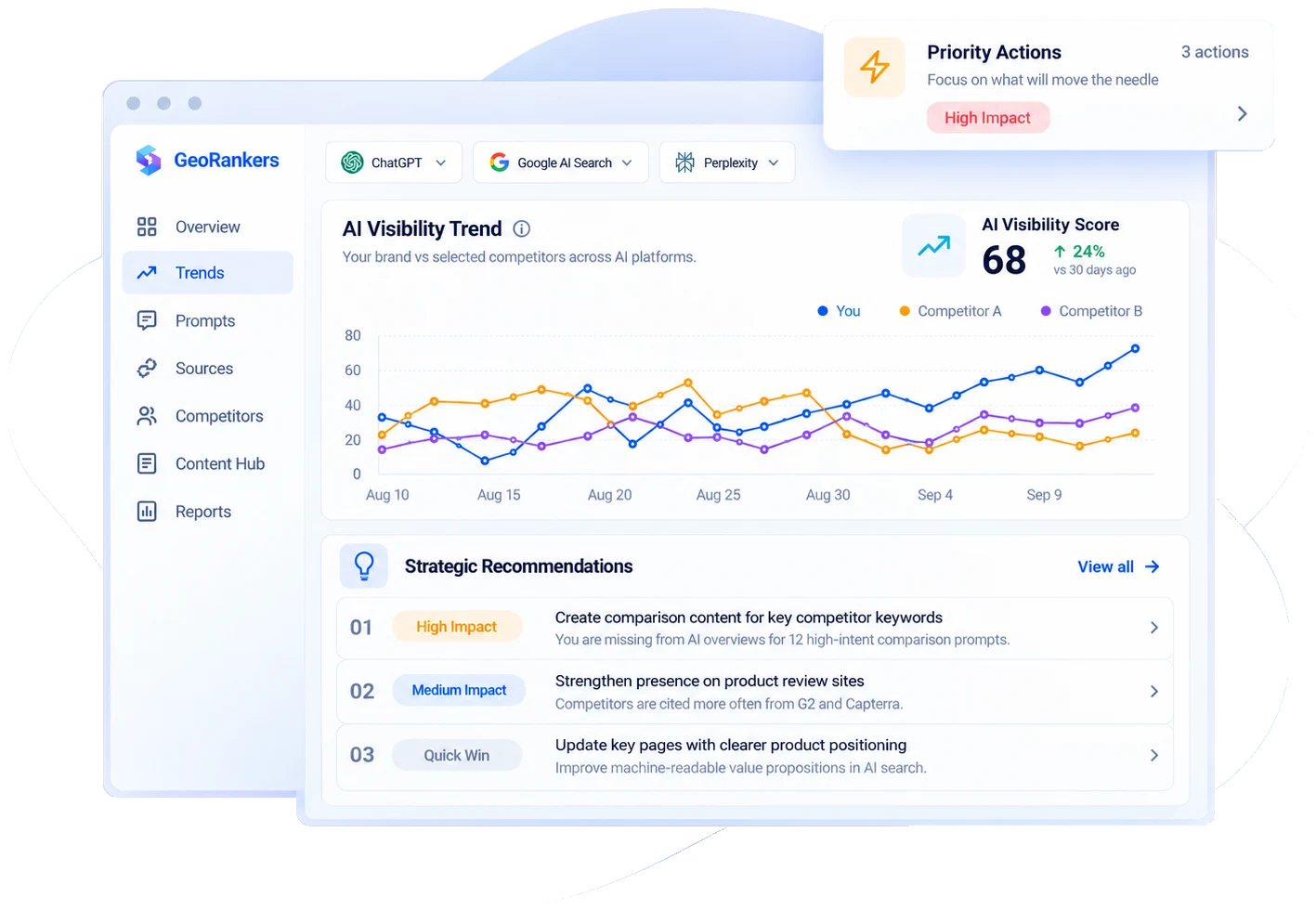
GeoRankers tracks a sample of prompts and groups mentions, competitors and citations. Its measurements describe the answers the tool analysed, not every real conversation. Our GeoRankers listing documents its stated scope, pricing and limitations. Test your own buying questions before deciding whether ongoing monitoring is worth the cost.
GEO audit mistakes to avoid
- Testing only your brand name, without need or comparison queries.
- Comparing scores from tools that use different prompts and models.
- Treating a citation as an endorsement.
- Confusing impressions, mentions and visits.
- Buying on the promise of a score or guaranteed visibility.
- Rewriting your whole site instead of improving the pages that help customers decide.
Frequently asked questions
How can I tell whether my business appears in ChatGPT?
Ask ChatGPT real questions from your customers in the search mode you want to evaluate. Record the date, country, prompt, brands and linked sources, then repeat the same prompt set later. This gives you a record of observed answers, not ChatGPT’s full conversation history or a guaranteed position.
Is there a Google report for visibility in AI answers?
Google announced Search Console reporting for AI Search experiences and said the global rollout was complete as of August 31, 2026. These views complement Google Search data but do not inventory every answer from ChatGPT, Claude or Perplexity. Check which reports are actually available in your property.
Does GEO replace SEO?
No. Google says SEO best practices remain useful for generative features, including crawlability, useful content, internal links and page experience. GEO adds ways to observe mentions and citations in answers; it does not replace SEO or measuring business outcomes.
Does an AI visibility score prove I will get more customers?
No. A score depends on the prompts, models, countries and sampled answers. It can help compare your own observations over time if the protocol stays consistent. To assess business impact, separately track visits, enquiries and sales without automatically attributing every change to a GEO tool.
The practical takeaway
Measuring AI search visibility in 2026 is not about chasing the highest score. Build a prompt set close to a buying decision, repeat tests, record sources and errors, then compare them with Search Console and your conversions. Google’s new reports add a signal for AI Search; measurement across other assistants remains sample-based. Pay for a tool only when it makes this process more useful for your business.
Primary sources, checked October 7, 2026: Google Search Central, AI features and your website; Google, new reporting for site owners; GeoRankers product changelog. Product capabilities are attributed to the vendor; no ranking or business outcome is invented.


